Growth of Intermediate-Mass Black Hole Seeds in Dense Star Clusters (in-prep)
Published:
Intermediate-mass black holes (IMBHs) are the elusive missing link between stellar-mass black holes and supermassive black holes. The interplay between gravitational dynamics and stellar evolution can lead to IMBH formation and growth of dense stellar environments, such as globular clusters. We analyzed simulation results from dense and massive globular cluster models simulated using MOCCA code in order to create detailed histories of IMBH growth in star clusters of varying initial central density, half-mass radius, binary fraction, mass, metallicty and initial mass function. A series of python based automated scripts were developed to analyze how IMBH seed was growing in simulations where IMBH formed through runaway collisions of stars and mergers with other black holes. The scripts were later assembled into MOCCA-BH-Forge (MOCCA-Blackhole-Forge). MOCCA-BH-Forge is an open-source simulation data visualization pipeline, designed to work with MOCCA output snapshots and history files.
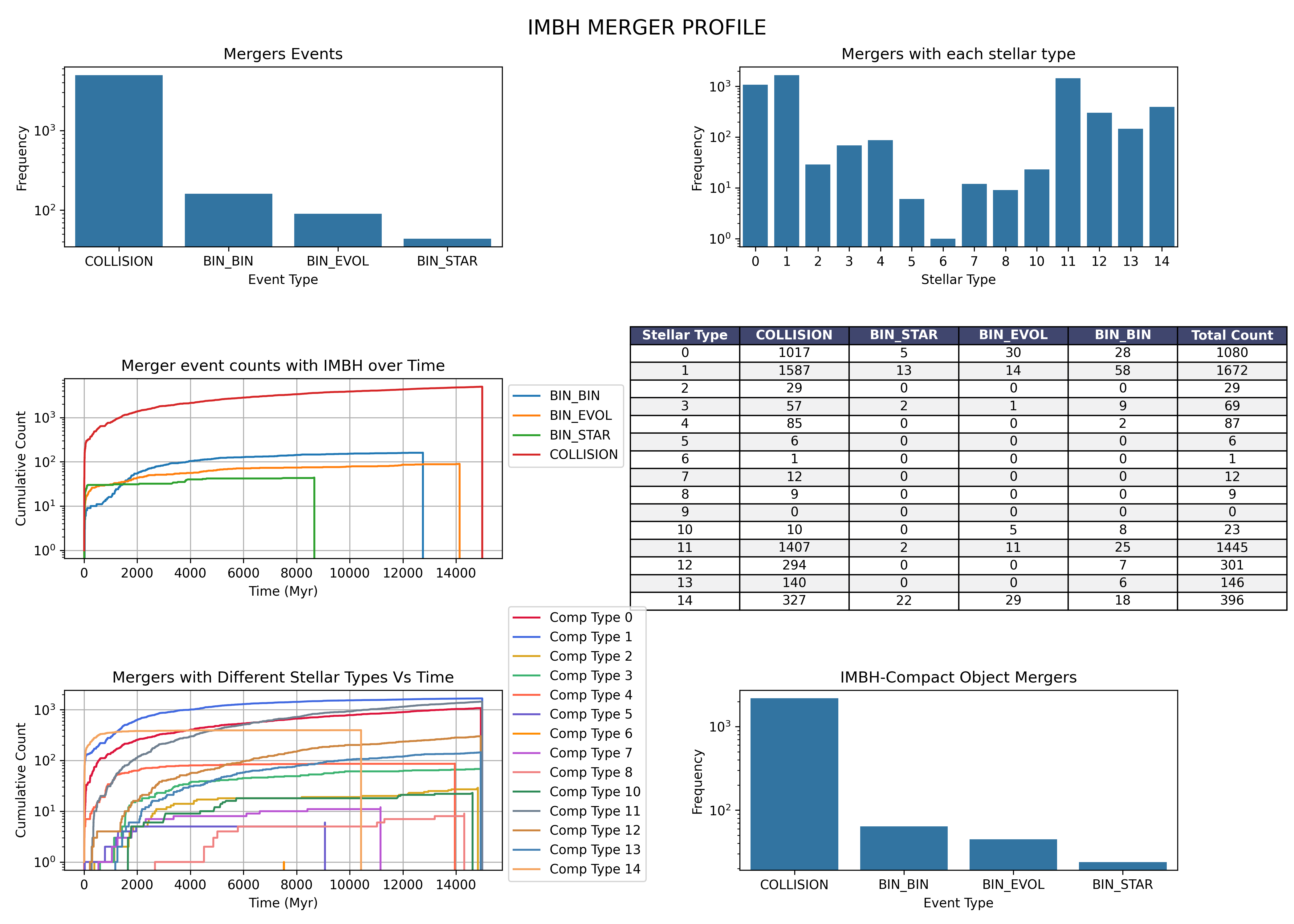
Detailed analysis of IMBH growth history was conducted using history files in MOCCA-BH-Forge. We found 2756 mergers with main-sequence stars out of which 2635 were collisions, 182 mergers were found involving evolved stars, 1523 involving white dwarfs, 137 involving neutron stars and 486 mergers involving stellar mass black holes. These collisions between MS stars, evolved stars, compact objects and IMBH are likely to lead to tidal disruption events. We also found hundreds of gravitational wave candidates with gravitational waves corresponding to the LISA detection range. These candidates were extracted from MOCCA-Survey Database I (Askar et al. 2017) using MOCCA-BH-Forge (see Figure 2)
Our research finds that globular clusters with initial densities of the order 10^7 M_sun/pc^3 tend to host the formation of an IMBH seed of ~1000 - 5000 M_sun through runaway collisions within few to tens of Myr. During the first Gyr of cluster evolution the IMBH grows by merging with other stellar mass black holes and by tidally disrupting stars. At late times it also merges with other compact objects. These mergers between IMBH-compact objects emit low-frequency gravitational waves which lie within the observable range of space-based gravitational-wave detectors like LISA. These tidal disruption events are relevant for future transient sky surveys.
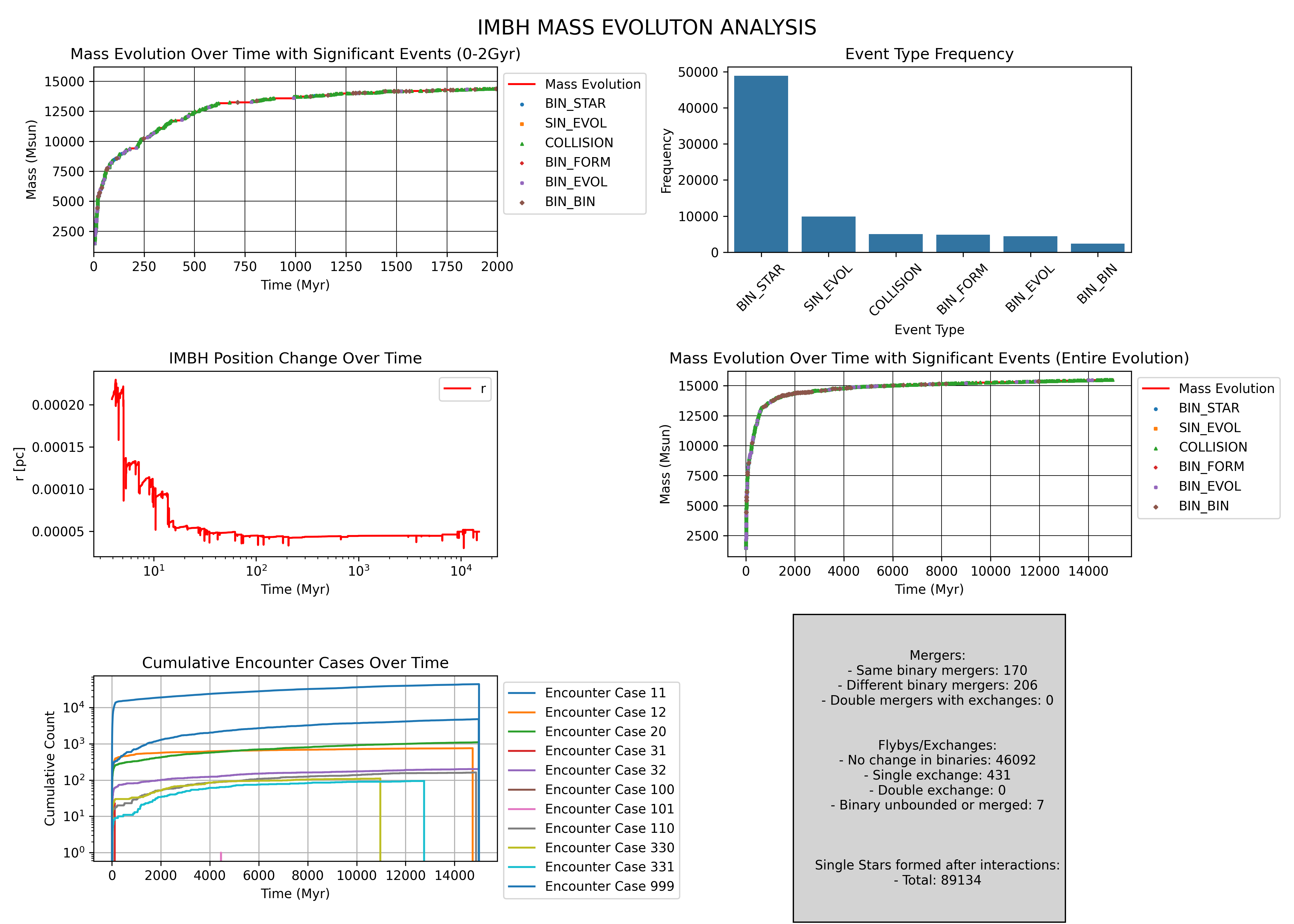
Figures 1 and 2 show summaries of all dynamical interaction events experienced by the IMBH from the time of its formation until the end of simulation, spanning 15 billion years, from one of our models. These events include tidal disruption events, binary-single interactions, binary-binary interactions, evolution and binary evolutions. Plots are generated from MOCCA-BH-Forge history file analysis.
Merger Events Leading to IMBH Growth in model-1-z0001